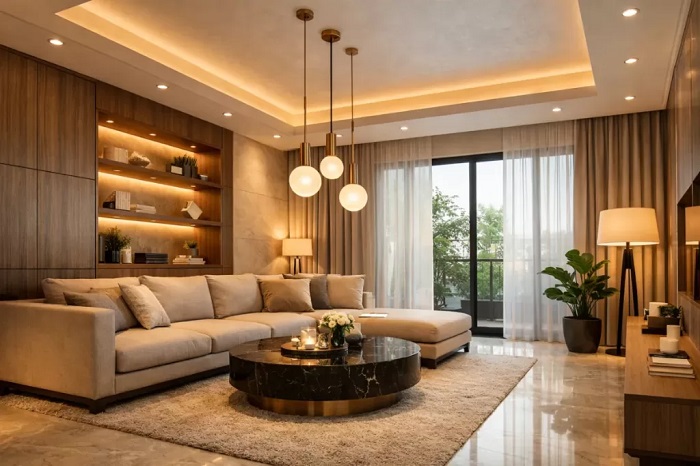
For decades, interior illumination was treated as a binary utility. A wall switch was flipped on at the start of the workday or evening, flooding a room with uniform, maximum-wattage light regardless of whether the space was full of people or empty, bathed in midday sunshine or cloaked in overcast gloom. While the rapid adoption of solid-state light-emitting diode (LED) fixtures significantly reduced overall wattage draw across residential and commercial sectors, swapping incandescent or fluorescent tubes for diodes addressed only half of the efficiency equation.
A high-efficiency fixture that runs at full output in an unoccupied, naturally illuminated room remains inherently wasteful. Modern architectural design increasingly recognizes that genuine energy conservation is not simply about lowering a luminaire’s baseline wattage; it is about calibrating light output dynamically to human presence, natural daylight, and specific functional needs. Integrated lighting control systems (LCS) have transitioned from novelty tech luxuries into fundamental structural tools, bridging the divide between architectural beauty and high-performance energy stewardship.
The Power of High-End Trim and Institutional Tuning
When architects and lighting designers calculate illumination levels for a new build or tenant improvement, they design for worst-case scenarios: the darkest evening hour, task-heavy visual demands, and the inevitable lumen depreciation of diodes over years of operation. The consequence is that newly commissioned spaces are routinely over-illuminated by twenty to thirty percent beyond what occupants actually require for visual comfort.
Intelligent control systems resolve this issue through a strategy known as high-end trim or institutional task tuning. Facility managers and designers can program a system-wide cap on maximum fixture output, scaling lighting levels back to seventy or eighty percent of factory capacity.
Because the human eye adapts dynamically to ambient light levels through pupillary dilation, occupants cannot perceive the difference between a luminaire running at full power versus one dialed down to eighty percent. Yet the energy reduction is immediate, measurable, and linear. Capping output at eighty percent directly slashes electrical consumption by twenty percent from day one, while simultaneously lowering operating temperatures at the circuit board. This thermal reduction extends the functional operating lifespan of both LED diodes and sensitive electronic driver components, keeping hardware out of replacement waste streams.
Responsive Automation: Occupancy Sensing Versus Vacancy Tuning
Human behavior is notoriously inconsistent when it comes to manual energy conservation. Occupants leave conference rooms, walk out of copy centers, and step away from residential home offices without switching off overhead lights. Automated sensing technologies eliminate human error by linking light activation directly to spatial usage.
Modern control architectures have moved past primitive passive infrared (PIR) sensors that plunge occupants into darkness if they sit still at a desk for five minutes. Today’s commercial and residential installations utilize dual-technology sensors that pair infrared heat-signature detection with micro-phonic acoustic sensors or ultrasonic motion tracking. These systems accurately identify micro-movements, such as typing or subtle shifting in an office chair, preventing false-off interruptions while eliminating false-on triggers caused by HVAC airflow.
The real efficiency breakthrough, however, lies in how these sensors are programmed:
-
Occupancy mode (Auto-On / Auto-Off): Lights illuminate automatically when someone enters a space and turn off after a programmed vacancy timeout. While convenient for public restrooms and stairwells, it can encourage unnecessary consumption when natural daylight is already sufficient.
-
Vacancy mode (Manual-On / Auto-Off): The occupant must physically press a switch to activate the fixtures, but the sensor automatically shuts the lights off once the room is deserted.
Field evaluations consistently demonstrate that vacancy-mode configurations achieve substantially higher energy savings than standard auto-on settings. When forced to make a deliberate choice, individuals frequently realize that ambient daylight is more than adequate for their brief visit, leaving the light switch untouched.
Daylight Harvesting: Harmonizing Natural and Artificial Light
Modern architectural envelopes increasingly emphasize expansive floor-to-ceiling glazing, clerestory windows, and deep light wells designed to pour natural daylight into building interiors. Without an automated control system, however, that natural sunlight simply sits alongside artificial illumination, producing harsh interior glare and wasting power.
Photosensor Calibration and Continuous Dimming
Daylight harvesting uses specialized photosensors mounted to ceilings or integrated directly into individual luminaires. These light sensors continuously measure ambient foot-candles at the work surface. As sunlight streams across perimeter window bays, the control system gradually and seamlessly dims the adjacent rows of interior fixtures to maintain a stable, uniform target light level.
Older systems relied on jarring step-dimming, dropping light levels in abrupt twenty-five-percent increments that irritated occupants and prompted tenants to tape over sensors. Modern continuous dimming drivers use logarithmic dimming curves that mirror human visual perception, adjusting lumen output in imperceptible micro-increments down to one percent or absolute zero. By shedding electrical loads in direct proportion to incoming daylight, facilities routinely cut lighting energy use in perimeter zones by forty to sixty percent over the course of a business year.
Networked Architectures and Luminaire-Level Flexibility
Historically, zoning a lighting system meant physically grouping dozens of fixtures onto dedicated electrical circuits wired back to a central breaker panel. If an office floor plan was reconfigured from an open-cubicle layout to private executive suites, updating the lighting zones required cutting drywall, pulling new copper conduit, and calling in licensed electricians for days of disruptive labor.
Contemporary interiors leverage Luminaire-Level Lighting Controls (LLLC) and digital addressable protocols such as DALI-2 (Digital Addressable Lighting Interface) or secure wireless mesh networks. In these environments, every single fixture houses its own microprocessor, wireless radio, and integrated sensor suite.
Fixtures communicate as an intelligent ecosystem, allowing property owners to regroup fixtures digitally through software interfaces without altering a single piece of copper wiring. When a desk pod is relocated or a communal break space is resized, zoning parameters can be redefined in minutes from a laptop or tablet. This granular control ensures that energy is deployed strictly where activity occurs, eliminating the traditional waste of lighting a five-hundred-square-foot zone to support a single worker at a desk.
The Thermal Multiplier: Reducing HVAC Burden
The energy benefits of lighting controls extend well beyond the electrical meter monitoring the lighting panel. A fundamental law of physics dictates that all electrical energy drawn by a light fixture is ultimately converted into heat energy dissipated into the surrounding room.
Even highly efficient LED fixtures shed significant convective and radiant heat into interior ceiling plenums and occupied spaces. During warm weather or in sunlit commercial floor plates, every watt of heat introduced by overhead luminaires must be actively countered and removed by the building’s mechanical heating, ventilation, and air conditioning (HVAC) systems.
By leveraging daylight harvesting, vacancy sensing, and high-end trim to reduce lighting loads, control systems significantly lower the parasitic thermal load placed on central chillers, heat pumps, and air handlers. For every two watts of lighting load reduced through automated controls, an additional mechanical cooling savings of approximately one watt is realized in building chiller performance. This thermal multiplier drastically reduces peak energy demand charges, protecting commercial facility budgets during sweltering summer afternoons when utility grid rates are at their highest.
Lighting control systems have elevated interior illumination from a passive design element into an active, responsive infrastructure. By aligning lumen output directly with human habits, environmental conditions, and mechanical realities, these systems prove that intentional efficiency does not require visual austerity. Instead, intelligent controls deliver an optimized visual environment that flatters architectural forms, elevates occupant well-being, and systematically reduces the carbon footprint of modern interior spaces.