For generations, the American residential bathroom was conceived almost exclusively through the lens of utilitarian efficiency. Tucked into standard five-by-eight footprints, lined with sterile white ceramic, and hidden behind solid doors, these rooms were designed to facilitate morning routines as quickly as possible. They were machines for hygiene, rarely spaces for lingering.
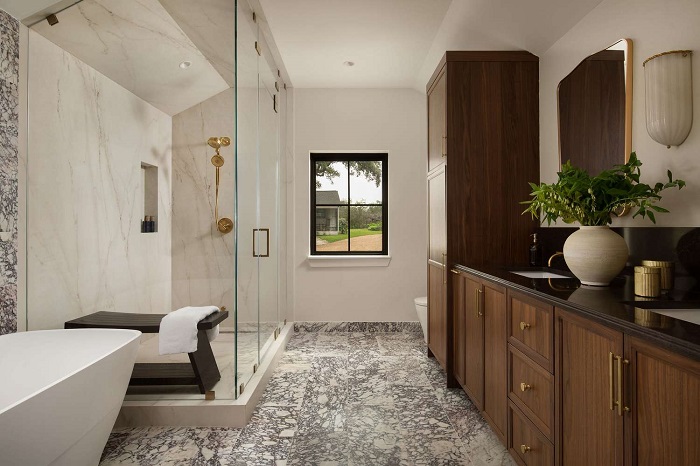
Over the past several years, that practical detachment has given way to a profound architectural shift. Homeowners and interior architects now treat the primary bathroom not as a functional necessity, but as an essential personal retreat and a centerpiece of residential design. As open-concept living continues to blur the boundaries between domestic zones, the bathroom has evolved into an experiential environment where materials, lighting, and layout prioritize sensory restoration, ergonomics, and spatial tranquility.
The Curbless Wet Room and Spatial Continuity
The most significant structural evolution in contemporary bathrooms is the eradication of visual and physical barriers. Traditional framed glass shower enclosures with high acrylic thresholds and sliding tracks are rapidly disappearing from modern renovations. In their place, designers are adopting the curbless wet room concept, creating a continuous, unbroken floor plane that stretches across the entire space.
By eliminating the raised curb, the bathroom immediately gains visual volume. Small rooms feel expansive because the eye is not stopped by floor-level dividing lines or heavy metal frames. Achieving this seamless transition requires pitching the shower floor gradually toward a hidden linear trench drain, often set flush against the rear wall or beneath a floating glass partition.
Beyond its dramatic visual appeal, the wet room fundamentally embraces universal design. The flat, uninterrupted threshold effortlessly accommodates varying life stages and mobility needs without carrying the clinical aesthetic once associated with accessible architecture. It is an engineering achievement that marries understated luxury with lifelong practicality.
Tactile Materiality: Moving Past the Sterile White Box
The era of the all-white, high-gloss bathroom is decisively over. Homeowners have grown fatigued by the cold, reverberant surfaces reminiscent of institutional spaces. Current design language focuses on warmth, depth, and organic tactility, turning to materials that invite touch and soften acoustic sharpness.
Monolithic Plasters and Microcement
Grout lines have long been the aesthetic and maintenance headache of bathroom walls. Modern bathrooms are increasingly turning to seamless alternatives like tadelakt and microcement. Originating as an ancient Moroccan plastering technique, waterproof lime-based tadelakt cures into a silky, water-repellent surface with subtle tonal variations that catch daylight beautifully. Microcement delivers a similar monolithic quality with an industrial edge, providing continuous, grout-free wall finishes that resist mold and require minimal scrubbing.
Fluted Millwork and Honed Natural Stone
To balance these expansive plaster or concrete surfaces, contemporary design introduces natural timber. Where polished marble and glossy subway tiles once dominated, designers now specify warm white oak, walnut, and teak vanity units, often treated with ribbed or fluted details that introduce fine shadow lines and visual rhythm.
Countertops and basins have shifted toward honed or leathered natural stones—such as quartzite, travertine, and dense soapstone—rather than reflective, high-gloss polished granite. These matte, textured finishes celebrate the raw, imperfect grain of the earth, reinforcing an organic connection that grounds the entire room in quiet sophistication.
Invisible Technology and Friction-Free Comfort
Residential technology often stumbles when it draws too much attention to itself. The most enduring modern bathroom innovations are those that operate invisibly, improving comfort and hygiene without cluttering surfaces with garish screens or blinking lights.
At the forefront of this shift is the integration of smart bidet toilets. Once seen as a niche luxury imported from overseas, wall-hung smart commodes featuring automated self-cleaning cycles, heated seats, customizable water temperatures, and integrated air purification have become a benchmark in upscale renovations. Mounting the bowl directly to the wall framework conceals the water tank behind drywall, creating a sleek silhouette that frees up valuable floor space and simplifies floor cleaning.
Simultaneously, plumbing engineering has embraced digital precision. Thermostatic digital shower valves allow users to activate custom temperature presets with a single touch, maintaining water heat within a fraction of a degree regardless of pressure changes elsewhere in the home. Paired with quiet, programmable radiant floor heating systems that warm cold stone tiles underfoot, modern bathroom technology focuses entirely on eliminating everyday friction.
Sculptural Vanities and Floating Architecture
Furniture in the modern bathroom is designed to hover. Bulky, floor-mounted cabinetry that runs corner-to-corner is yielding to floating vanities that expose the continuous flooring beneath.
Lifting cabinetry off the finished floor creates negative space, making the entire room appear larger and lighter on its foundation. These vanities are increasingly conceived as freestanding pieces of fine furniture, featuring integrated stone trough sinks, soft-close mitered drawers, and open lower shelves for rolled linen storage.
Wall-mounted faucets have emerged as the natural companion to this floating aesthetic. By routing supply plumbing through the wall studs rather than through the vanity deck, homeowners gain clean, uncluttered countertops that are effortless to wipe down. Finishes have also shifted away from high-shine polished chrome toward living finishes such as unlacquered brass, matte bronze, and brushed nickel, which age naturally alongside the home and resist water spots.
The Architecture of Atmospheric Lighting
Few elements dictate the emotional tone of an interior space as decisively as illumination. The historical approach of placing a harsh multi-bulb fixture directly above the vanity mirror casts unflattering shadows across the face and washes out the room with aggressive glare.
Modern bathroom design relies on layered, indirect lighting schemes that adapt across the day:
-
Concealed perimeter LED coves tucked into ceiling recesses or beneath floating vanities cast soft washes of ambient light, outlining the architectural boundaries of the room without exposing bare bulbs.
-
Vertical sconces mounted at eye level on either side of the mirror eliminate dark shadows, delivering even, flattering light across the face for daily grooming tasks.
-
Low-voltage toe-kick lighting and backlit mirrors wired to discreet motion sensors provide subtle, warm navigation pathways during nighttime hours, guiding occupants safely without shocking night-adjusted eyes.
Color temperature management has become paramount. Progressive designs integrate dimmable bulbs calibrated to a warm 2700K or 3000K spectrum, with some homeowners opting for tunable systems that shift from crisp morning light to deep amber evening tones to support natural circadian rhythms.
The modern bathroom is no longer viewed as a purely mechanical room isolated from the rest of the house. By blending architectural minimalism, honest materials, concealed engineering, and nuanced illumination, residential design has transformed this intimate space into a personal sanctuary. It stands as a testament to the belief that the spaces where we begin and conclude our days deserve the highest degree of design consideration, functional craftsmanship, and enduring beauty.